
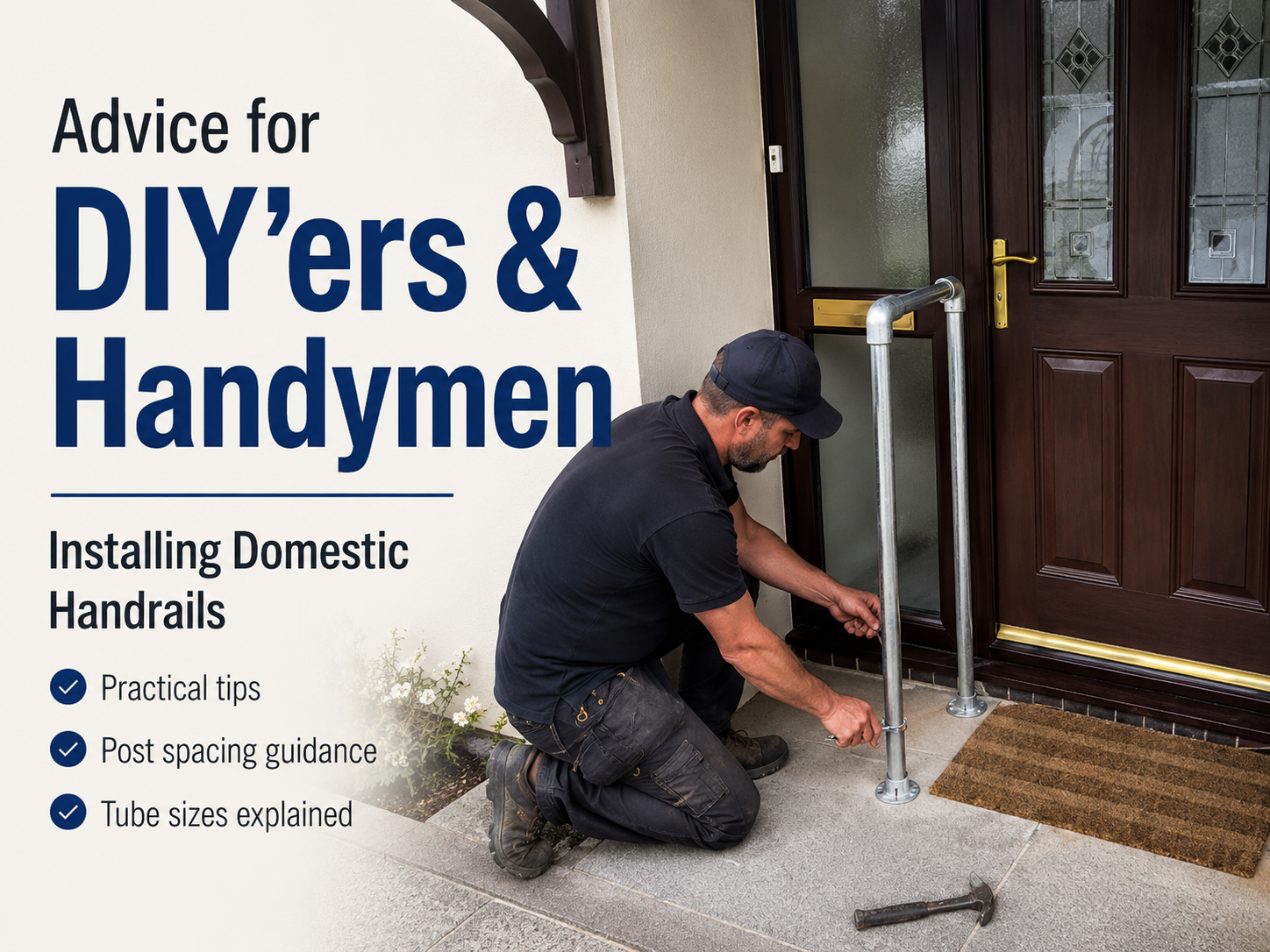
Advice for DIY’ers and Handymen Installing Domestic Handrails
Key clamp handrails are a popular choice for household projects because they are strong, modular and easy to assemble without welding. For many home users, they offer a practical way to add extra support around steps, paths, garden areas, garages, workshops and general domestic access points.
Before fitting any handrail, it is important to understand where DIY installation is suitable, and where extra advice may be needed.
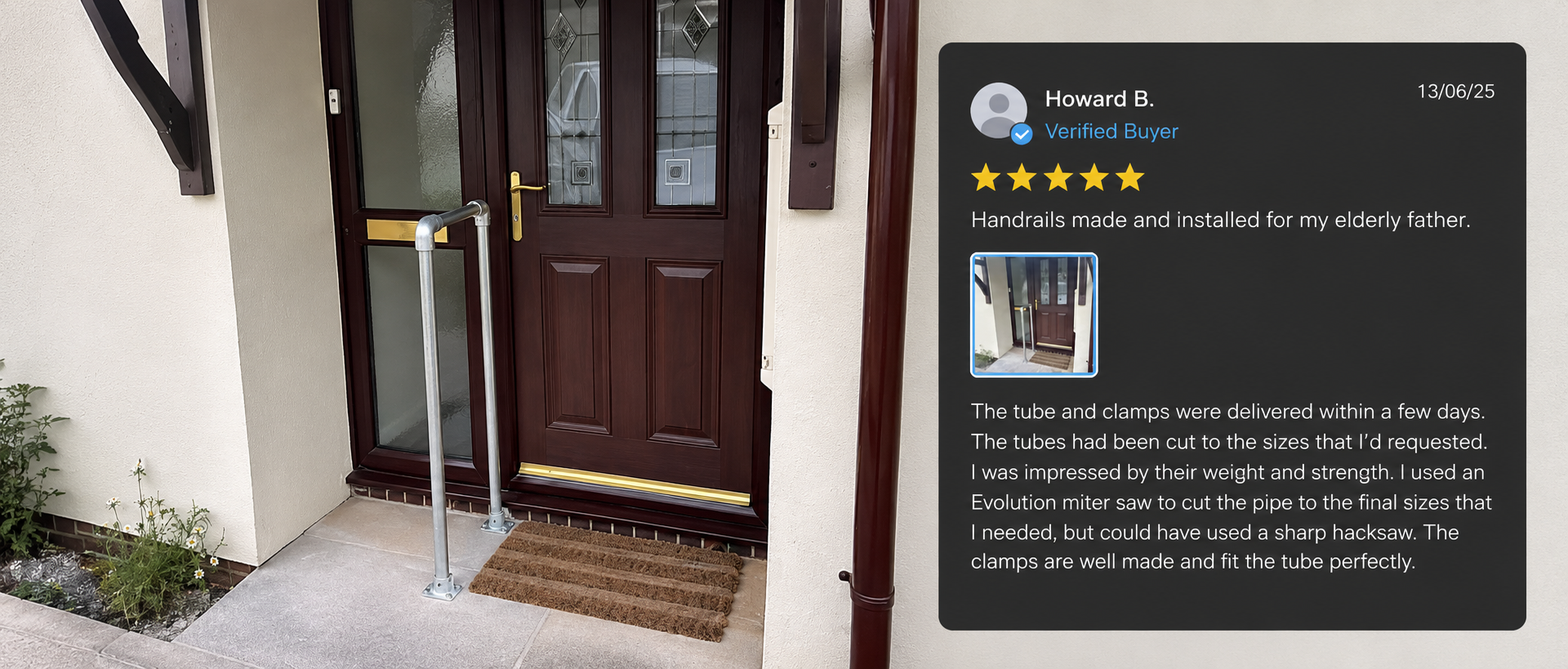
Can handrails be fitted by DIY users or handymen?
In many general household situations, yes. Domestic handrails can often be fitted by competent DIY users, handymen or general tradespeople, provided the installation is safe, secure and suitable for the location.
A typical home handrail used for light support or guidance does not usually need to be fitted by a specialist contractor. However, the responsibility sits with the installer to make sure the rail is properly fixed, correctly assembled and appropriate for its intended use.
The key point is that safety depends on the completed installation, not just the fittings or tube. A handrail is only as reliable as the surface it is fixed into, the fixings used, the post spacing, the tube size and the quality of the installation.
Where are DIY domestic handrails commonly used?
Key clamp handrails are often used around the home for:
- Garden steps and paths
- Garage and workshop access
- Domestic ramps
- Low-level edge guidance
- Steadying rails for older or less mobile users
- General household handrail projects
For these types of domestic applications, a key clamp system can be a straightforward and effective option.
When should you get extra advice?
Extra care is needed where the handrail or barrier protects against a fall, forms part of a staircase, landing, balcony, raised platform, ramp or any area where Building Regulations may apply.
You should also seek project-specific advice for commercial premises, public access areas, schools, clubs, crowd-loading areas or any installation that needs formal approval.
Image Placeholder: Close-up of key clamp fittings, tube and a base plate fixing.
Suggested domestic post spacing
For general household handrail and light domestic barrier use, post centres of up to 1.6 metres are commonly used. This is a practical spacing because it allows a standard 6.4 metre tube to be divided into four equal sections, reducing waste while still giving a sturdy domestic installation.
For a stronger or more rigid feel, closer post centres can be used. This is especially useful where the rail may be leaned on regularly or where the fixing surface is less certain.
42.4 mm or 48.3 mm tube?
For most household projects, 42.4 mm tube is suitable for general domestic handrails and light-duty barriers.
Where a stronger, more robust handrail is preferred, 48.3 mm tube is the better choice. It gives a sturdier feel and is a sensible option where the rail may be used frequently for support.
Important reminder
This advice is for general domestic handrail and light household barrier use only. It is not intended for balconies, commercial guarding, public areas, crowd loading, work at height, vehicle protection or formal Building Control approval.
Before installing, always check that the substrate is sound, the fixings are suitable, the fittings are correctly tightened and the finished handrail is safe for its intended use.
For more detailed guidance on tube sizes, post spacing, loading assumptions, fixings and domestic installation notes, read our full DIY and handyman handrail advice guide.